Ultra-high-density IR barriers Arnica
In a nutshell. Arnica barriers form a dense "curtain" of many invisible infrared beams between a transmitter and a receiver. Arnica-1 has up to 144 beams, and an alarm is raised if at least one of them is blocked; Arnica-2 detects not only the movement of an exhibit or an intruder's hand, but also thin objects 5–10 mm across — a knife, a screwdriver, an aerosol spray can. They are used in museums, galleries and exhibition centres, to protect windows, doors and openings, and also as a warning barrier around hazardous areas.
Physical principle of operation
The transmitter emits many parallel near-infrared beams invisible to the eye; the beams are modulated — they "flicker" at a specific frequency. The receiver is tuned to that frequency and extracts only its own signal, ignoring ambient light: the sun, lamps, reflections from surfaces.
The receiver's photodetector continuously measures the level of incoming radiation for each beam; when an intruder blocks a beam, the signal power drops sharply — the receiver registers the loss and raises an alarm.
The barrier density — the spacing between adjacent beams — determines its resolution: the more beams, the thinner the objects it can detect, from a few centimetres for simple systems to 5–10 mm for the ultra-high-density Arnica-2 barriers.
Ultra-high-density IR barriers Arnica-1
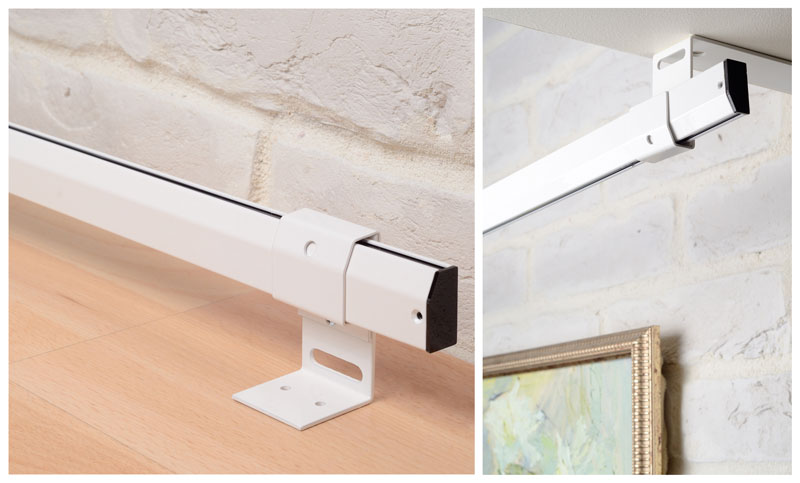
Arnica-1 is an active multi-beam IR detector for protecting exhibits. It provides early detection of threats of removal or damage to works of art placed on walls, stands and exhibition panels (museums, galleries, exhibition centres).
It is also used:
- to protect windows, doors, openings and passages in residential and industrial premises;
- as a warning barrier around hazardous areas.
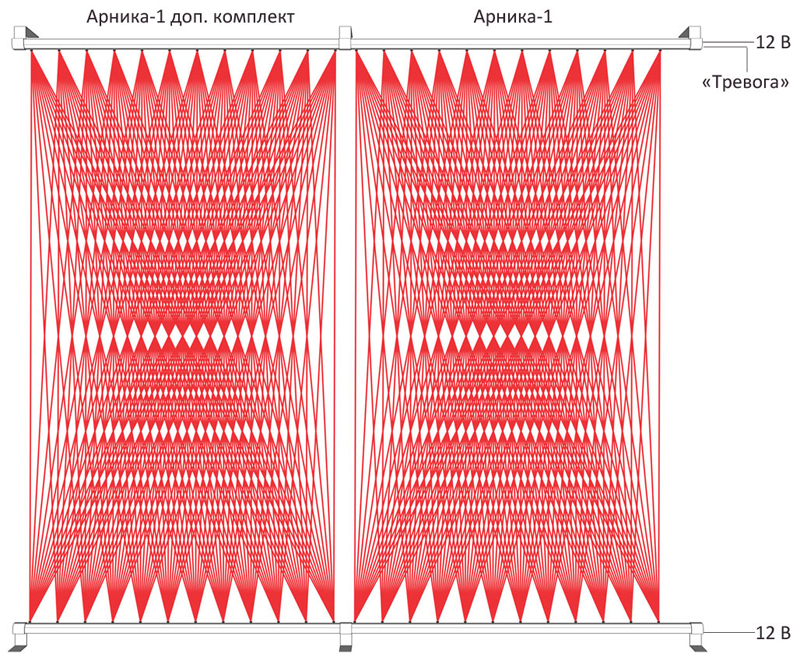
The device consists of a transmitter unit (TU) and a receiver unit (RU) installed on opposite sides of the detection zone. Between them a dense IR curtain of 144 beams is formed — crossing even a single beam generates an "Alarm" notification.
Ultra-high-density IR barriers Arnica-2
The key difference of Arnica-2 is its ability to detect not only the movement of an exhibit or an intruder's hand, but also thin objects 5–10 mm across: a knife, a screwdriver, an aerosol spray can. An attacker cannot damage the exhibit even without moving it from its place.
The detector raises an alarm when IR radiation between the "M" and "S" units is blocked.
Application areas:
- timely detection of threats to damage or remove works of art on walls, stands and exhibition panels;
- protection of door and window openings;
- warning people about intrusion into hazardous areas.
The detectors are installed indoors in museums, galleries, exhibition centres and other halls (including for protecting private collections). The units are mounted on vertical surfaces on brackets.
Power supply:
- from 3.6 V type C lithium cells (capacity 8.5 Ah) — one battery lasts for approximately 6 months of post operation;
- from a mains adapter;
- from a 12 or 24 V DC power source.
The detector output is relay contacts: closed in the normal state, they open on alarm. The alarm signal is generated in both units.
Dimensions of the Arnica 2K detectors
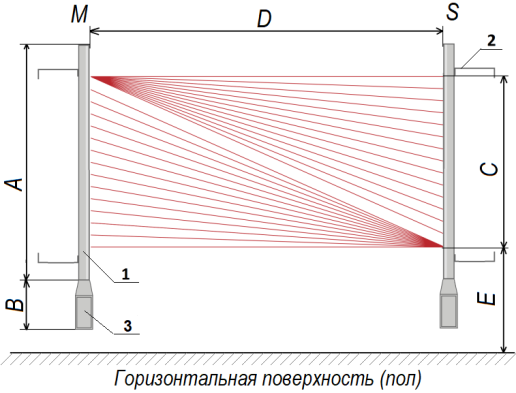
1 – detector unit; 2 – bracket; 3 - battery compartment
| Variant | A, mm | B, mm | C, mm | D, m | E, mm | Number of beams |
|---|---|---|---|---|---|---|
| Arnica 2K-1 | 480 | 124 | 270 | from 3 to 35 | from 240 | 8 |
| Arnica 2K-2 | 860 | 124 | 650 | from 3 to 35 | from 240 | 16 |
| Arnica 2K-3 | 1240 | 124 | 1030 | from 3 to 35 | from 240 | 24 |
Dimensions of the Arnica 2P detectors
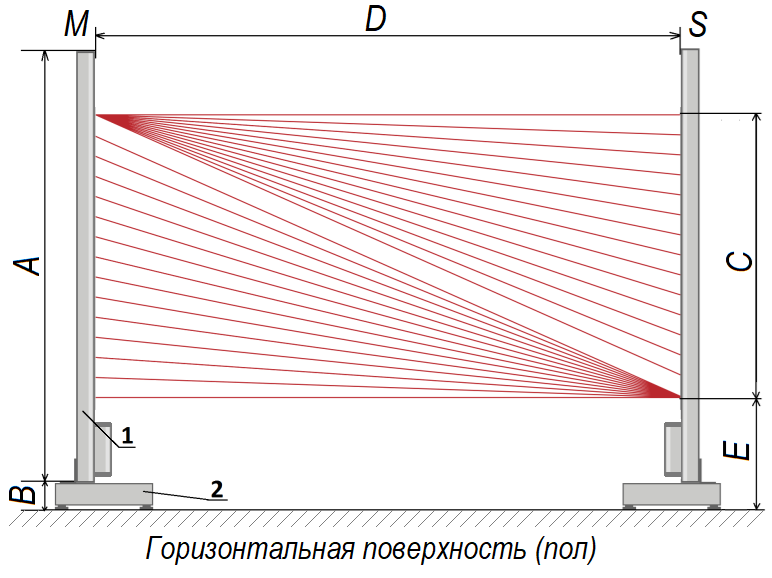
1 – detector unit; 2 – pedestal
| Variant | A, mm | B, mm | C, mm | D, m | E, mm |
|---|---|---|---|---|---|
| Arnica 2P-3 | 1364 | 50 | 1030 | from 3 to 35 | 290 |
| Arnica 2P-3.1 | 1934 | 50 | 1030 | from 3 to 35 | 770 |
Dimensions of the Arnica 2Sh detectors

1 – detector unit; 2 – tripod
| Variant | A, mm | B, mm | C, mm | D, m | E, mm |
|---|---|---|---|---|---|
| Arnica 2Sh-3 | 1364 | from 950 to 1900 | 1030 | from 3 to 35 | from 290 to 1200 |